

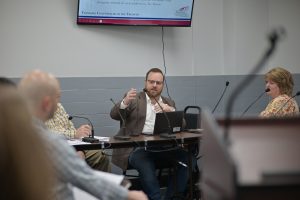
Ryan Duggin
JAMES WOOD
Staff Writer
Assistant Director of Property Assessments at the State Comptroller’s Office Ryan Duggin prepared a presentation for the Senior Tax Freeze Study Committee on March 10 to share information on what a tax freeze is according to state law and its potential implications in the county.
Among those in attendance were County Mayor Chad Graham, Shelbyville Mayor Randy Carroll, former Property Assessor Ronda Clanton and several other County Commissioners and City Councilmembers.
Duggin clarified several important points about local tax freezes during the presentation, including who would be eligible, how the county government handles frozen properties, and the history of tax relief law in the state.
According to him, the Property Tax Freeze Act of 2007 states that a property cannot exceed five acres and the owner must be 65 or older by Dec. 31 of the year of application to the tax freeze. Applicants must also reapply and requalify each year.
The owner’s income also cannot exceed the specified county limit, with the baseline level being $38,470 annual income. According to the Comptroller’s Office, the standard income limit in Bedford County is $43,780 per year.
State law defines the standard income limit in each locality as the average of the median household income for age groups 65 to 75 years old.
Properties exceeding five acres in size still may be eligible, with all other parts of the property being excluded from the tax freeze based on individual parcels being the basis of how property taxes are calculated.
Shelbyville City Councilmember Josh Blevins sought to clarify with Duggin that property owners will still be paying taxes, however their rates will remain the same after they apply for the freeze.
“Even the senior citizens that have their taxes frozen continue to pay property taxes,” Blevins said.
Physical changes to the property also will still be accounted for as well each year by the Property Assessor’s office.
“These are just some of the typical things the Assessor sees in their office that are going to have to be accounted for with the tax freeze if it’s voted in,” Duggin said.
The plan will also involve cooperation between multiple parties in the local governments, including the Trustee, Property Assessor, County Commission and more.